

فهرست مطالب
Introduction
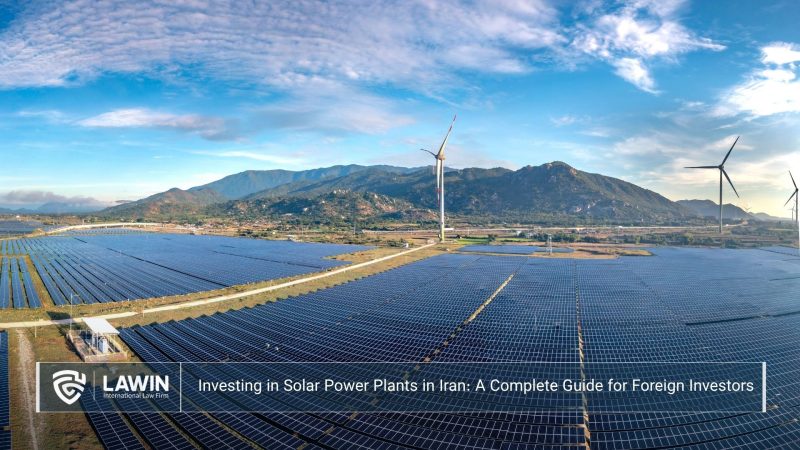
Iran is emerging as a potentially important market for renewable energy investment, particularly solar power. The country has extensive land resources, high solar irradiation in many regions, a large domestic electricity market, and a structural need to increase electricity generation capacity.
For foreign investors, however, investing in a solar power plant in Iran requires considerably more than selecting a suitable site and installing photovoltaic panels. A successful project requires careful analysis of the regulatory framework, project company structure, land rights, construction permits, environmental approvals, grid connection, power sales arrangements, financing, foreign investment rules, taxation, currency risks and international sanctions.
The Iranian renewable energy framework is primarily administered through the Ministry of Energy and the Renewable Energy and Energy Efficiency Organization, commonly known as SATBA. Iranian law provides mechanisms for the development of renewable power plants by private investors and includes guaranteed electricity purchase arrangements. Article 61 of the Energy Consumption Pattern Reform Law provides the legal basis for long-term purchase of renewable electricity.
This article provides a practical and legal overview of investing in solar power plants in Iran, with particular emphasis on the issues that a foreign investor should examine before committing capital to a solar project.
Important note: Electricity tariffs, procurement mechanisms, licensing requirements, grid rules and foreign investment procedures may be amended by the Iranian authorities. Therefore, investors should obtain a current legal and regulatory review before signing binding project documents or transferring capital.
1. Why Invest in Solar Power Plants in Iran?
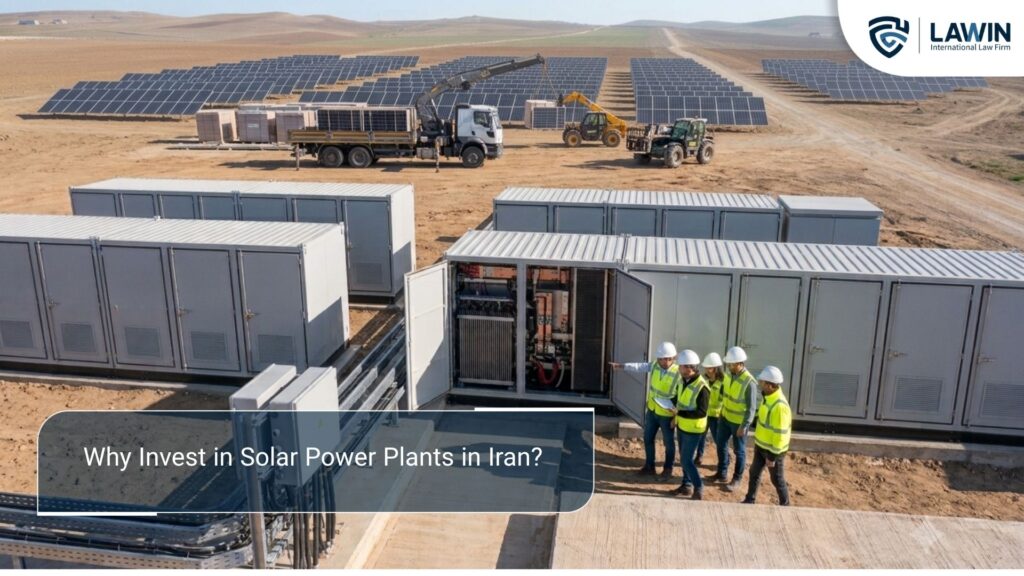
Iran has several characteristics that make solar energy attractive from an investment perspective.
1.1. High Solar Potential
Large parts of Iran, particularly the central, southern and southeastern regions, have significant solar irradiation.
The country’s solar resource is especially attractive in provinces and areas such as:
- Yazd
- Kerman
- Fars
- Semnan
- South Khorasan
- Sistan and Baluchestan
- Isfahan
- Hormozgan
Site selection should nevertheless be based on a bankable solar resource assessment rather than simply relying on regional averages.
The investor should evaluate:
- Global Horizontal Irradiance (GHI)
- Direct Normal Irradiance (DNI)
- annual sunshine hours
- temperature
- dust and soiling
- wind conditions
- topography
- flooding risk
- access roads
- proximity to transmission infrastructure
- grid capacity
- environmental restrictions
1.2. Growing Electricity Demand
Iran has a large electricity market and has experienced periods of electricity supply shortages, particularly during peak summer demand.
This creates an important investment rationale for renewable generation: solar power can contribute generation during periods when electricity demand is particularly high.
1.3. Government Support for Renewable Energy
Iran’s renewable energy framework provides several mechanisms intended to encourage private-sector investment.
These mechanisms may include:
- Guaranteed Power Purchase Agreements;
- Renewable electricity trading;
- bilateral electricity contracts;
- green electricity transactions;
- renewable energy certificates and environmental attributes;
- specific procurement programmes;
- projects developed under Article 12 of the Law on Removing Barriers to Competitive Production;
- self-consumption and industrial renewable-energy projects.
The exact availability and commercial terms of each mechanism must be verified at the time of project development.
2. Who Regulates Solar Power Investment in Iran?
A foreign investor should understand the institutional structure before entering the Iranian solar market.
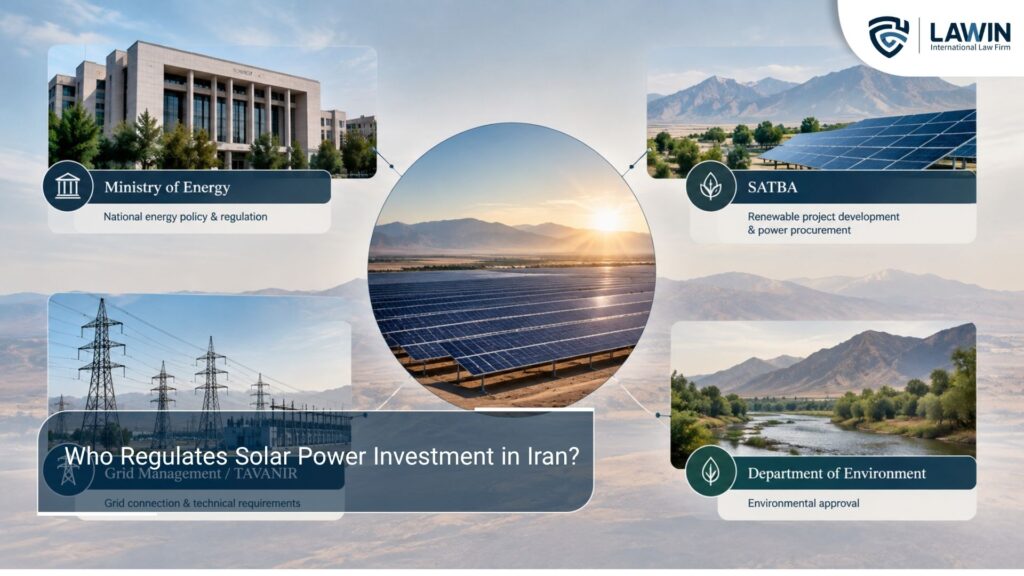
2.1. Ministry of Energy
The Ministry of Energy is the principal governmental authority responsible for Iran’s electricity sector and renewable energy policies.
It establishes major policies relating to:
- electricity generation;
- transmission;
- distribution;
- renewable energy;
- electricity procurement;
- electricity market development.
2.2. SATBA
The Renewable Energy and Energy Efficiency Organization (SATBA) operates under the Ministry of Energy and plays a central role in renewable energy development.
SATBA is particularly important for:
- renewable project licensing;
- renewable project registration;
- power purchase arrangements;
- administration of renewable procurement mechanisms;
- supervision of renewable power projects.
Historically, SATBA has been the principal governmental counterparty for guaranteed renewable electricity purchase arrangements.
2.3. Iran Grid Management Company and TAVANIR
Grid connection requires coordination with the relevant electricity network authorities.
The project developer must determine:
- the point of connection;
- available grid capacity;
- required substations;
- transmission or distribution facilities;
- technical requirements;
- metering requirements;
- protection systems.
A solar project with an attractive tariff but without a viable grid connection should not be considered investment-ready.
2.4. Department of Environment
Environmental approval is an important component of project development.
Depending on the location, size and characteristics of the project, environmental assessment and approval may be required.
Environmental due diligence should be performed before the investor acquires or commits to long-term land rights.
3. The Legal Structure of a Solar Power Project
A foreign investor should normally establish a dedicated project structure rather than investing directly in every aspect of the project.
A common structure is:
Foreign Investor → Iranian Project Company (SPV) → Solar Power Plant
The Special Purpose Vehicle, or SPV, may be responsible for:
- obtaining permits;
- securing land;
- signing the PPA;
- financing the project;
- entering EPC contracts;
- purchasing equipment;
- constructing the plant;
- operating and maintaining the plant;
- selling electricity;
- receiving project revenues.
The structure should be determined after considering:
- FIPPA protection;
- taxation;
- foreign ownership;
- financing;
- repatriation of capital and profits;
- applicable bilateral investment treaties;
- sanctions;
- banking arrangements;
- dispute resolution.
4. Foreign Investment in Iranian Solar Projects
Foreign investors should distinguish between project licensing and foreign investment authorization.
They are separate matters.
A solar power plant may require sector-specific permits from Iranian authorities, while foreign capital may also be admitted under the Foreign Investment Promotion and Protection Act (FIPPA).
Under FIPPA, the Organization for Investment, Economic and Technical Assistance of Iran (OIETAI) is the governmental body responsible for foreign investment matters. Foreign investment applications are considered through the Foreign Investment Board.
4.1. FIPPA Investment Licence
A foreign investor seeking protection under FIPPA should generally consider obtaining a foreign investment licence.
The legal framework covers matters including:
- admission of foreign capital;
- contribution of cash;
- machinery and equipment;
- technology and know-how;
- certain intellectual property rights;
- repatriation of capital;
- transfer of profits;
- legal protection of investment.
FIPPA defines foreign investment broadly and provides mechanisms for admitting foreign capital into Iranian economic enterprises.
4.2. Is 100% Foreign Ownership Possible?
Foreign ownership structures must be assessed on a case-by-case basis.
Iranian foreign investment law generally permits foreign investment in activities where private-sector participation is permitted, subject to the statutory limitations and applicable sectoral rules.
Therefore, an investor should not assume that a particular project structure is automatically permissible merely because it is a renewable-energy project.
The proposed ownership structure should be reviewed before incorporation and capital commitment.
5. Obtaining a Permit to Construct a Solar Power Plant in Iran
Obtaining a construction permit is one of the most important stages of project development.
The process should be viewed as a sequence rather than a single licence.
A typical project-development process includes:
Project concept → Site selection → SATBA application → Land arrangements → Environmental approval → Grid study → Grid connection approval → Construction licence → PPA / electricity sale arrangement → Construction → Commissioning → Operation
The precise sequence can vary depending on the project structure and applicable procurement mechanism.
6. Step-by-Step Solar Power Plant Licensing Process
Step 1: Define the Project
The investor should first determine:
- proposed capacity;
- technology;
- project location;
- land requirements;
- financing structure;
- electricity buyer;
- intended revenue model.
For example, a 10 MW utility-scale photovoltaic project will have materially different land, grid, financing and contractual requirements from a 200 kW distributed project.
Step 2: Select and Verify the Site
Site selection is one of the most important investment decisions.
The investor should conduct legal and technical due diligence on the land.
The investigation should cover:
Legal due diligence
- title;
- ownership;
- cadastral status;
- boundaries;
- mortgages;
- liens;
- litigation;
- easements;
- government claims;
- land-use restrictions;
- agricultural classification;
- protected areas;
- rights of third parties.
Technical due diligence
- solar irradiation;
- terrain;
- slope;
- soil conditions;
- flooding;
- access roads;
- proximity to electricity infrastructure;
- telecommunications;
- water requirements;
- security.
7. Land for Solar Power Plants
Land can be obtained through different structures depending on the project.
Possible arrangements include:
Private land
The project company may:
- purchase land;
- lease land;
- enter into a long-term land-use agreement;
- establish other contractual rights over the site.
Government-owned land
Government land may require specific approvals, allocation procedures or agreements with the competent governmental authority.
The investor should avoid acquiring land solely on the assumption that it will eventually receive the required renewable-energy approvals.
Land due diligence should precede significant capital expenditure.
8. Environmental Approval
Environmental issues should be addressed at an early stage.
The investor should determine whether the proposed site is affected by:
- protected environmental areas;
- wildlife habitats;
- agricultural restrictions;
- water resources;
- archaeological or cultural heritage restrictions;
- military or security restrictions;
- transmission corridors;
- other land-use constraints.
Environmental approval should be treated as a project condition precedent where appropriate.
9. Grid Connection
Grid connection is one of the most important technical and commercial risks in an Iranian solar project.
A project may have:
- an excellent solar resource;
- suitable land;
- an attractive tariff;
but still be commercially unviable if the grid cannot absorb the generated electricity without excessive connection costs or delays.
The grid study should determine:
- connection voltage;
- connection point;
- required substation;
- transmission line requirements;
- transformer requirements;
- protection systems;
- metering;
- network reinforcement;
- estimated connection costs;
- construction schedule.
A foreign investor should therefore obtain a preliminary grid assessment before making an irreversible investment decision.
10. Power Purchase Agreement in Iran
One of the most important documents in a renewable energy project is the Power Purchase Agreement (PPA).
Under Iran’s renewable-energy framework, guaranteed purchase arrangements have historically been structured as long-term contracts.
The IEA’s description of Iran’s renewable feed-in tariff framework states that renewable PPAs may have a 20-year term, with tariff adjustment mechanisms and specific provisions affecting the second decade of the contract.
The PPA effectively determines the project’s revenue model and therefore directly affects:
- project valuation;
- debt capacity;
- investor return;
- bankability;
- refinancing;
- project risk.
11. What Should a Foreign Investor Examine in the PPA?
A detailed legal review of the PPA should cover at least the following.
11.1. Contract Term
Determine:
- initial term;
- extension mechanisms;
- renewal rights;
- post-expiration electricity sales.
11.2. Tariff
The investor must determine:
- base tariff;
- adjustment mechanism;
- currency reference;
- inflation adjustment;
- capacity-related tariff;
- storage-related tariff;
- local-content incentives;
- applicable deductions.
11.3. Payment Mechanism
The investor should examine:
- invoicing;
- payment deadlines;
- payment currency;
- bank arrangements;
- late-payment interest;
- security mechanisms;
- payment guarantees;
- dispute procedures.
11.4. Curtailment
The PPA should be reviewed for the treatment of:
- grid congestion;
- dispatch limitations;
- forced outages;
- curtailment;
- deemed generation;
- compensation.
11.5. Force Majeure
This is particularly important for international investors.
The clause should address:
- natural disasters;
- war;
- sanctions;
- government actions;
- regulatory changes;
- grid failures;
- import restrictions;
- currency restrictions.
12. Solar Electricity Prices in Iran
Electricity pricing in Iran is not based on a single universal tariff.
The applicable price depends on:
- project capacity;
- electricity sales mechanism;
- procurement programme;
- project technology;
- contractual structure;
- applicable government regulations;
- whether storage is incorporated;
- whether the electricity is sold through a market mechanism or under a guaranteed purchase agreement.
12.1. Guaranteed Purchase Tariffs
As of 2026, the Iranian Ministry of Energy has issued updated guaranteed purchase rates for renewable power.
Reported 1405 rates include:
| Solar Project Category | Base Guaranteed Purchase Rate |
|---|---|
| Solar plants up to 200 kW | 58,540 IRR/kWh |
| Solar plants up to 200 kW with storage | 91,169 IRR/kWh |
| Solar plants between 200 kW and 1 MW | 46,386 IRR/kWh |
These rates are based on the 1405/2026 regulatory framework and should be verified against the applicable official notification before financial closing.
For larger utility-scale projects, investors should not simply extrapolate the small-scale guaranteed tariff. The applicable procurement mechanism must be determined based on the project’s capacity and contractual structure.
13. Electricity Sales Models for Solar Power Plants in Iran
A solar investor should evaluate several possible electricity-sales models.
Model 1: Guaranteed Power Purchase Agreement
Under this model, electricity is sold under a long-term government-backed procurement framework administered through the renewable-energy system.
Advantages
- predictable revenue framework;
- long-term contract;
- easier financial modelling;
- reduced merchant-price exposure.
Disadvantages
- regulatory dependence;
- payment risk;
- currency and inflation issues;
- potentially limited upside;
- dependence on applicable procurement rules.
14. Selling Electricity Through the Electricity Market
Iran has been developing market-based mechanisms for renewable electricity transactions.
Renewable generators can, subject to applicable rules and qualification requirements, participate in electricity-market structures, including the Green Electricity Board / Green Board of the Iran Energy Exchange.
The development of renewable electricity trading has created an alternative to relying exclusively on traditional guaranteed-purchase arrangements.
For example, a renewable plant can potentially sell electricity to eligible subscribers or retailers through market mechanisms, subject to licensing and market-access requirements.
This model can be particularly interesting for:
- industrial consumers;
- large commercial consumers;
- electricity-intensive businesses;
- companies seeking renewable electricity;
- projects seeking market-based revenues.
15. Bilateral Power Purchase Agreements
Another possible model is a bilateral electricity sale between the renewable generator and an eligible consumer.
This structure can potentially provide:
- negotiated pricing;
- long-term customer relationships;
- reduced reliance on a single government purchaser;
- improved alignment between generation and consumption.
However, the legal and regulatory requirements for bilateral transactions must be carefully reviewed.
The contract should address:
- electricity quantity;
- delivery point;
- price;
- adjustment mechanism;
- imbalance;
- curtailment;
- credit support;
- termination;
- force majeure.
16. Self-Consumption and Industrial Solar Projects
A company with substantial electricity consumption may develop a solar project primarily to supply its own electricity requirements.
This model can be attractive where:
- industrial electricity prices are significant;
- electricity shortages affect production;
- the consumer requires energy security;
- renewable-energy obligations apply;
- the company wants to reduce exposure to grid electricity.
The project may be developed on-site or through an off-site structure, depending on the applicable regulatory framework.
17. Article 12 Investment Mechanism
Foreign investors should also examine projects developed under Article 12 of the Law on Removing Barriers to Competitive Production and Improving the Financial System.
Article 12 structures may be relevant where renewable projects generate economic savings or replace conventional energy consumption.
The commercial structure is different from a conventional fixed-tariff PPA and must be assessed based on the specific government procurement and investment programme applicable to the project.
For large-scale projects, this mechanism can be particularly relevant and should be considered during project structuring.
18. Renewable Energy Certificates and Green Attributes
Renewable projects may also create environmental attributes in addition to physical electricity.
Depending on the applicable Iranian market framework, these may include:
- renewable energy certificates;
- green electricity attributes;
- environmental benefits.
Investors should determine whether these attributes:
- belong to the generator;
- are transferred to the electricity purchaser;
- can be separately traded;
- can be used by corporate consumers;
- can be monetized.
The contractual treatment of environmental attributes should be expressly addressed in the electricity-sale agreement.
19. Financing Solar Power Projects in Iran
Financing is one of the most important challenges for foreign investors.
The financing structure should be designed before finalizing the project.
Potential sources include:
19.1. Equity Financing
The investor contributes capital directly to the project company.
Advantages:
- simple structure;
- no debt service;
- greater control;
- lower financial leverage.
Disadvantage:
- higher amount of investor capital at risk.
20. Local Bank Financing
Iranian banks may potentially provide project or corporate financing subject to their lending policies and applicable regulations.
The investor should assess:
- interest rate;
- loan tenor;
- collateral;
- debt service schedule;
- security over project assets;
- guarantees;
- foreign currency exposure;
- repayment source.
Because Iranian interest rates and inflation can materially affect project economics, financing assumptions should be stress-tested.
21. Foreign Financing
International financing can theoretically provide:
- lower-cost capital;
- longer maturities;
- export-credit financing;
- equipment financing;
- development finance.
However, the Iranian market presents significant practical constraints for international banking transactions.
International sanctions, banking restrictions and correspondent-banking limitations can affect:
- fund transfers;
- project finance;
- insurance;
- equipment procurement;
- guarantees;
- international EPC contracts;
- foreign currency payments.
Sanctions should therefore be treated as a central component of project due diligence rather than as a peripheral issue. Recent international assessments continue to identify sanctions and limited access to international finance as significant constraints on renewable-energy investment in Iran.
22. Export Credit Agency Financing
For projects involving foreign equipment suppliers, an investor may investigate:
- Export Credit Agencies (ECAs);
- supplier credit;
- buyer credit;
- equipment leasing;
- structured trade finance.
The feasibility of such financing depends heavily on the nationality of the supplier, applicable sanctions and the ability of banks and insurers to legally participate.
23. Project Finance vs. Corporate Finance
A major structural decision is whether the project will be financed through:
Corporate finance
The parent company guarantees the project debt.
Project finance
The project company and project revenues are the primary source of repayment.
For a large utility-scale solar project, project finance may provide greater scalability, but lenders will require confidence in:
- the PPA;
- grid connection;
- land rights;
- EPC contract;
- O&M agreement;
- insurance;
- payment security;
- project cash flows.
24. EPC Contract
The Engineering, Procurement and Construction contract is one of the most important commercial documents.
The investor should carefully negotiate:
- fixed price;
- completion date;
- performance guarantees;
- minimum power output;
- module degradation;
- liquidated damages;
- delay damages;
- warranty;
- spare parts;
- commissioning;
- testing;
- change orders;
- force majeure;
- sanctions;
- import restrictions.
For foreign investors, the EPC contract should also allocate currency and supply-chain risks.
25. Operation and Maintenance Agreement
A solar project is normally operated for decades.
The O&M agreement should cover:
- preventive maintenance;
- corrective maintenance;
- inverter maintenance;
- module cleaning;
- monitoring;
- spare parts;
- response time;
- availability guarantees;
- performance ratio;
- security;
- insurance claims.
The investor should model long-term degradation and replacement costs.
26. Solar Equipment and Local Content
The availability of equipment is a critical consideration.
Typical equipment includes:
- photovoltaic modules;
- inverters;
- transformers;
- mounting structures;
- cables;
- switchgear;
- protection systems;
- SCADA;
- monitoring equipment;
- batteries where applicable.
The investor should examine Iranian rules relating to:
- domestic manufacturing;
- local content;
- import licences;
- customs;
- standards;
- technical certification;
- approved equipment;
- procurement restrictions.
Local-content requirements can also affect the economics of government-supported projects.
Historical Iranian renewable tariff regulations have included incentives associated with domestic know-how, design and manufacturing.
27. Taxation

A solar investment should be analysed from a tax perspective before incorporation.
The investor should review:
- corporate income tax;
- value-added tax;
- withholding taxes;
- customs duties;
- import taxes;
- payroll taxes;
- property-related taxes;
- tax incentives;
- tax exemptions;
- depreciation;
- transfer pricing;
- double taxation arrangements.
Tax treatment may vary depending on:
- project location;
- legal structure;
- free-zone status;
- project type;
- foreign ownership;
- financing structure.
A tax model should therefore be prepared as part of the financial feasibility study.
28. Currency Risk
Currency risk is one of the most important issues for foreign investors in Iran.
The project may have:
- capital expenditures denominated in EUR or USD;
- operating costs denominated in IRR;
- electricity revenues denominated in IRR;
- tariffs linked partially or indirectly to foreign exchange indicators.
The investor should therefore analyse:
EUR/USD → IRR → project revenue → debt service → dividend → repatriation
A nominally attractive IRR tariff does not automatically produce an attractive foreign-currency return.
29. Inflation Risk
Iran has experienced significant inflationary pressures.
Therefore, the financial model should not rely solely on:
- nominal revenue;
- nominal IRR profit;
- simple payback period.
Instead, investors should calculate:
- real IRR;
- nominal IRR;
- USD/EUR-equivalent IRR;
- NPV;
- project IRR;
- equity IRR;
- DSCR;
- sensitivity to inflation.
30. Sanctions and Compliance Risk
Any foreign investor considering an Iranian solar project should conduct a sanctions analysis before entering the transaction.
This should include:
- investor jurisdiction;
- ultimate beneficial owners;
- banks;
- EPC contractor;
- equipment suppliers;
- insurers;
- shipping companies;
- technology providers;
- payment channels;
- counterparties;
- governmental entities.
US, EU, UK and other sanctions regimes may apply differently depending on the nationality and activities of the investor.
A foreign investor should obtain specialist sanctions advice before:
- transferring funds;
- importing equipment;
- signing contracts;
- opening bank accounts;
- engaging Iranian counterparties.
The practical significance of sanctions should not be underestimated. Even where Iranian domestic law permits an investment, international sanctions may affect the investor’s ability to finance, insure, supply or repatriate proceeds from the project.
31. Repatriation of Capital and Profits
For a foreign investor, the ability to eventually move money out of Iran is as important as the ability to bring money into Iran.
Under FIPPA, foreign investment law addresses the admission and repatriation of foreign capital and provides legal protections for qualifying investments. Applications concerning the inflow, use and outflow of foreign capital fall within the OIETAI framework.
Nevertheless, investors should distinguish between:
legal entitlement and practical ability to transfer funds internationally.
Currency controls, banking restrictions and international sanctions can materially affect the practical execution of repatriation.
This issue should therefore be incorporated into the investment structure from the beginning.
32. Political and Regulatory Risk
Renewable energy projects are long-term investments.
A solar plant may operate for 20 years or longer.
The investor should therefore analyse:
- changes in electricity tariffs;
- changes in tax rules;
- changes in environmental regulations;
- changes in foreign investment rules;
- changes in grid regulations;
- currency restrictions;
- changes in government procurement;
- political risk;
- sanctions;
- governmental payment risk.
Contracts should contain appropriate protections against adverse regulatory changes.
33. Dispute Resolution

A foreign investor should pay particular attention to dispute resolution.
Project contracts should clearly specify:
- governing law;
- dispute-resolution mechanism;
- arbitration institution;
- seat of arbitration;
- language;
- enforcement;
- interim measures.
Depending on the transaction and applicable legal framework, arbitration may be considered.
However, investors should not assume that an arbitration clause automatically eliminates enforcement risk.
The enforceability of awards, sovereign-immunity considerations and the location of assets should be analysed separately.
34. Bilateral Investment Treaties
The investor’s country of incorporation can be highly relevant.
Before investing, counsel should determine whether Iran has a bilateral investment treaty or other investment-protection arrangement with the investor’s home country.
This may affect:
- fair and equitable treatment;
- protection against expropriation;
- transfer of funds;
- dispute settlement;
- investor-state arbitration.
The investment should ideally be structured only after analysing the available treaty protections.
35. Insurance

Insurance should be considered during project development, not after construction.
Potential coverage may include:
- construction all-risk insurance;
- machinery breakdown;
- business interruption;
- third-party liability;
- property insurance;
- political risk insurance;
- terrorism and war risks where available;
- marine cargo insurance.
International sanctions can make some forms of insurance difficult or impossible to obtain.
36. Due Diligence Checklist for Foreign Investors
Before investing in an Iranian solar project, the investor should complete at least the following due diligence.
Legal
- company structure;
- ownership;
- land title;
- permits;
- environmental approvals;
- grid connection;
- PPA;
- EPC contract;
- O&M agreement;
- financing documents;
- tax;
- sanctions;
- dispute resolution.
Technical
- solar resource;
- energy yield;
- equipment;
- degradation;
- grid;
- construction conditions;
- site access;
- climate;
- dust;
- water;
- security.
Financial
- CAPEX;
- OPEX;
- tariff;
- revenue;
- taxes;
- financing;
- inflation;
- exchange rate;
- IRR;
- NPV;
- DSCR;
- sensitivity analysis.
Commercial
- electricity buyer;
- PPA;
- payment history;
- market demand;
- electricity market access;
- equipment supply;
- EPC contractor;
- O&M provider.
37. Recommended Investment Structure
For a foreign investor, a carefully structured project may follow this sequence:
Phase 1 — Investment Feasibility
- Market analysis;
- legal feasibility;
- sanctions screening;
- technical feasibility;
- financial modelling;
- preliminary site selection.
Phase 2 — Investment Structuring
- Establish project company;
- determine ownership;
- prepare FIPPA application if appropriate;
- structure financing;
- negotiate shareholder arrangements.
Phase 3 — Project Development
- secure land;
- obtain construction licence;
- obtain environmental approvals;
- obtain grid approval;
- complete technical studies;
- negotiate PPA/electricity-sale agreement.
Phase 4 — Financing and Construction
- financial close;
- EPC contract;
- equipment procurement;
- construction;
- grid connection;
- testing and commissioning.
Phase 5 — Operation
- commercial operation;
- electricity sales;
- invoicing and collection;
- O&M;
- financial reporting;
- dividend distribution;
- long-term asset management.
38. Investment Timeline
The exact project timeline varies considerably.
A simplified development timeline may be:
| Stage | Indicative Activities |
|---|---|
| Preliminary feasibility | Site and market assessment |
| Legal due diligence | Land, permits, regulatory review |
| Project registration | SATBA / relevant authority |
| Grid studies | Connection point and technical approval |
| Environmental process | Environmental assessment/approval |
| Foreign investment | FIPPA/OIETAI process where applicable |
| Contracting | PPA, EPC, O&M, financing |
| Construction | Civil works and equipment installation |
| Commissioning | Testing and grid synchronization |
| Operation | Electricity generation and sale |
The timeline should not be treated as a guaranteed statutory timetable. Project delays can result from land, grid, environmental, procurement, financing or regulatory issues.
39. What Makes an Iranian Solar Project Bankable?
For an institutional or foreign investor, the following characteristics significantly improve bankability:
- clear land title;
- valid construction licence;
- completed environmental approval;
- confirmed grid connection;
- long-term electricity-sale agreement;
- reliable offtaker;
- transparent tariff adjustment;
- enforceable contractual rights;
- experienced EPC contractor;
- strong O&M arrangement;
- reliable equipment;
- appropriate insurance;
- compliant foreign-investment structure;
- sanctions-compliant payment structure;
- realistic currency assumptions.
The most important principle is simple:
A solar power plant is not merely an engineering project; it is a long-term contractual and financial asset.
40. Key Risks for Foreign Investors
The principal risks can be divided into six categories.
Regulatory Risk
Changes in laws, tariffs or procurement rules.
Currency Risk
Depreciation of the Iranian rial and difficulty converting or transferring revenues.
Payment Risk
Delay or disruption in payments by electricity purchasers.
Grid Risk
Connection delays, congestion or curtailment.
Construction Risk
Cost overruns, delays and equipment problems.
Sanctions Risk
Restrictions affecting banking, financing, equipment, insurance and international payments.
A professional investment model should quantify each risk rather than simply listing it.
41. How to Evaluate the Return on Investment
A foreign investor should calculate at least:
Project IRR
The internal rate of return of the entire project.
Equity IRR
The return earned by shareholders after debt service.
NPV
The net present value of future project cash flows.
Payback Period
The period required to recover the initial investment.
DSCR
The Debt Service Coverage Ratio for financed projects.
Currency-adjusted return
The return measured in EUR, USD or the investor’s reporting currency.
A project can have a high nominal IRR in Iranian rials while producing a substantially lower return in euros or US dollars.
42. Example of a Simplified Solar Investment Model
Suppose an investor develops a hypothetical 10 MW solar PV plant.
The financial model should include:
Initial investment
- land;
- development;
- engineering;
- modules;
- inverters;
- structures;
- transformers;
- grid connection;
- construction;
- financing costs.
Annual operating costs
- O&M;
- security;
- insurance;
- land;
- administration;
- replacement components;
- cleaning.
Revenue
- electricity production × applicable tariff;
- market electricity sales where applicable;
- renewable certificates or other environmental attributes where legally monetizable.
The model should then apply:
- degradation;
- curtailment;
- inflation;
- exchange rate;
- tax;
- financing;
- payment delays;
- tariff adjustments.
Only after these factors are incorporated should the investor determine whether the project is economically attractive.
43. Common Mistakes Made by Foreign Investors

Foreign investors should avoid several common mistakes.
Mistake 1: Buying Land Before Checking the Grid
A cheap and sunny site may be useless if the grid cannot accept the project.
Mistake 2: Relying on an Old Tariff
Iran’s renewable electricity tariffs can change.
The applicable tariff must be verified at the time of investment.
Mistake 3: Treating the PPA as a Standard Contract
The PPA determines the project’s revenue and should receive institutional-level legal review.
Mistake 4: Ignoring Currency Risk
IRR profitability does not necessarily equal EUR/USD profitability.
Mistake 5: Ignoring Sanctions
A transaction may be lawful under Iranian law but problematic under the investor’s home-country sanctions regime.
Mistake 6: Assuming FIPPA Solves All Investment Risks
FIPPA can provide an important legal framework, but it does not eliminate practical banking, currency, political or sanctions risks.
44. Questions a Foreign Investor Should Ask Before Investing
Before committing capital, the investor should be able to answer:
- Who owns the land?
- Is the land legally usable for a solar project?
- Has the project obtained the necessary SATBA approvals?
- Is the construction permit valid?
- Has the grid connection been confirmed?
- Who will purchase the electricity?
- What is the applicable tariff?
- How is the tariff adjusted?
- What is the PPA term?
- What happens if the purchaser delays payment?
- Who bears curtailment risk?
- What happens if the law changes?
- Can foreign capital be admitted under FIPPA?
- How will capital enter Iran?
- How will dividends leave Iran?
- Which bank will process payments?
- Does the investor’s jurisdiction permit the transaction?
- Are sanctions applicable?
- Is political-risk insurance available?
- What is the project’s EUR/USD-equivalent IRR?
If these questions cannot be answered satisfactorily, the project should generally not proceed to financial close.
45. Legal Services Required for a Foreign Solar Investor
A foreign investor entering Iran’s renewable-energy sector normally benefits from a multidisciplinary legal team covering:
Foreign Investment
- FIPPA;
- investment licensing;
- ownership structure;
- repatriation;
- investment protection.
Energy Law
- SATBA;
- renewable licences;
- PPA;
- electricity market;
- grid connection.
Real Estate
- land title;
- lease;
- acquisition;
- government land;
- easements.
Corporate Law
- SPV;
- shareholders’ agreement;
- governance;
- capital increase;
- corporate approvals.
Contracts
- EPC;
- O&M;
- PPA;
- financing;
- equipment procurement;
- land agreements.
Tax
- corporate tax;
- VAT;
- customs;
- withholding;
- foreign-investor taxation.
International Trade
- import;
- customs;
- equipment procurement;
- international payments.
Sanctions and Compliance
- investor screening;
- counterparty screening;
- banking;
- payment channels;
- equipment suppliers;
- insurance.
46. Final Investment Roadmap
For a foreign investor, the recommended approach is:
1. Market Screening
↓
2. Preliminary Feasibility Study
↓
3. Sanctions & Compliance Screening
↓
4. Site Identification
↓
5. Land Due Diligence
↓
6. Grid Feasibility
↓
7. SATBA / Regulatory Process
↓
8. Environmental Approval
↓
9. Foreign Investment Structuring / FIPPA
↓
10. PPA or Electricity Sales Structure
↓
11. Financial Model
↓
12. Financing
↓
13. EPC & Equipment Procurement
↓
14. Construction
↓
15. Grid Connection & Commissioning
↓
16. Commercial Operation
↓
17. Electricity Sales & Revenue Collection
Conclusion
Investing in solar power plants in Iran can offer significant opportunities for investors seeking exposure to the renewable-energy sector. Iran combines substantial solar resources with a large electricity market and a regulatory framework that provides several mechanisms for private renewable-energy investment.
However, the attractiveness of a solar project cannot be assessed solely by looking at the amount of sunlight or the headline electricity tariff.
For a foreign investor, the real investment question is the interaction between:
land + permits + grid + PPA + tariff + financing + currency + taxation + sanctions + repatriation + dispute resolution.
The most important stage is therefore not construction but project structuring and due diligence before financial commitment.
A properly structured project should have clear land rights, a viable grid connection, an appropriate electricity-sale mechanism, a robust contractual structure, a realistic financial model and a foreign-investment structure compatible with Iranian law and the investor’s home jurisdiction.
Because Iran’s renewable-energy regulations and electricity tariffs continue to evolve, investors should verify the applicable rules, tariff and procurement mechanism immediately before committing capital. The 2026 tariff revisions demonstrate why using historical tariff tables for a new investment can lead to materially incorrect financial projections.
For foreign investors, the appropriate strategy is therefore not simply to build a solar power plant in Iran, but to build a legally protected, financeable and commercially bankable renewable-energy project.
Frequently Asked Questions
Is solar energy a good investment in Iran?
Iran has substantial solar potential and a significant electricity market, making solar power an important investment opportunity. However, profitability depends on the project’s location, tariff, electricity-sale mechanism, financing cost, currency risk, grid connection and regulatory conditions.
Can foreigners invest in solar power plants in Iran?
Foreign investment in Iran is regulated by the Foreign Investment Promotion and Protection Act (FIPPA). The Organization for Investment, Economic and Technical Assistance of Iran (OIETAI) is the principal governmental authority responsible for foreign investment admission and related matters.
What is SATBA?
SATBA is Iran’s Renewable Energy and Energy Efficiency Organization. It operates under the Ministry of Energy and plays a central role in renewable-energy project licensing and electricity procurement.
Does Iran offer a guaranteed purchase price for solar electricity?
Yes. Iran has a regulatory framework for guaranteed purchase of renewable electricity, including long-term PPAs. The applicable tariff depends on the project and the current regulatory framework.
What is the solar electricity tariff in Iran in 2026?
Under the 1405 framework, reported base guaranteed purchase rates include 58,540 IRR/kWh for solar projects up to 200 kW, 91,169 IRR/kWh for qualifying projects up to 200 kW with storage, and 46,386 IRR/kWh for projects between 200 kW and 1 MW. The applicable tariff should always be verified against the current official notification and project-specific conditions.
How long is a renewable-energy PPA in Iran?
Iran’s renewable-energy framework has provided for long-term PPAs, historically including 20-year contracts. Specific current contractual terms should be confirmed for the relevant procurement programme.
Can solar electricity be sold through the Iranian electricity market?
Subject to the applicable rules and qualifications, renewable generators can participate in market-based electricity transactions, including the Green Board mechanisms of the Iran Energy Exchange.
What are the biggest risks for a foreign solar investor in Iran?
The principal risks include regulatory changes, currency depreciation, payment delays, grid constraints, financing restrictions, sanctions, equipment procurement, taxation and difficulty in repatriating funds.
Does FIPPA eliminate sanctions risk?
No. FIPPA is an Iranian domestic investment-protection framework. It does not automatically override sanctions or banking restrictions applicable to a foreign investor under the law of its home jurisdiction or other applicable jurisdictions.
What should a foreign investor do before investing?
The investor should conduct legal, technical, financial, tax, land, grid, foreign-investment and sanctions due diligence before committing significant capital.
About Lawin
Lawin provides legal and business advisory services to investors and companies seeking to enter or expand their activities in Iran.
For foreign investors considering solar power projects in Iran, legal support may include:
- Foreign investment structuring;
- FIPPA investment licensing;
- Solar project licensing;
- SATBA procedures;
- Power Purchase Agreements;
- Land and real-estate due diligence;
- EPC and O&M contracts;
- Project financing;
- Corporate structuring;
- Tax and customs;
- International commercial contracts;
- Sanctions and compliance;
- Dispute resolution.
A foreign investor should ideally involve legal counsel before acquiring land, signing a PPA, establishing the project company or transferring investment capital.